Most of the details of this section can be found in (Sosnica et al. 2026). We relate here only some important aspects. The definition of ILuRS and of its realization ILuRF is highly dependant on planetary and lunar ephemerides. In 2025, there are 3 state-of-the-art ephemerides with similar accuracies : DE430, INPOP21a and EPM21 . Comparisons between these 3 solutions can be retrieved for example in (Fienga et al. 2024). These 3 ephemerides were selected for the construction of ILuRS first realization, ILuRF2026. The implementation of DE440 is discussed in (Sosnica et al. 2026). Same weights have been taken for all the parameters of the combinations. The combination has been built from 1970 to 2050. This version of ILuRS realization is labelled ILuRF2026.
Validation of ILuRF2026 is obtained by using the ILuRF2026 defining parameters (LOOP, LLRRR coordinates and other auxiliary parameters required for data analysis) for LLR data analysis. Three validations using independant software have been implemented. The results of the two first using INPOP and EPM software are presented in (Sosnica et al. 2026). Results of the third validation using ESA sofware can be found here .
LLR Retroreflector Positions in TDB (extracted from Sosnica et al. 2026)
The positions of LLR retroreflectors (LLRRR) in PA ILuRF and in TDB. Please note that the positions of the Next Generation Lunar Retroreflector (NGLR-1) are preliminary due to the short time series of observations (since March 2025).
| Retroreflector | X [m] | Y [m] | Z [m] |
|---|---|---|---|
| Apollo 11 | 1591966.745 | 690699.384 | 21003.764 |
| Apollo 14 | 1652689.627 | -520997.633 | -109730.514 |
| Apollo 15 | 1554678.397 | 98095.451 | 765005.257 |
| Luna 17 | 1114292.301 | -781298.502 | 1076058.718 |
| Luna 21 | 1339363.512 | 801871.855 | 756358.706 |
| NGLR-1 | 776672.915 | 1448359.255 | 552205.021 |
LLR Retroreflector Positions in TCB/TCL (deduced from Sosnica et al. 2026)
The positions of LLR retroreflectors (LLRRR) in PA ILuRF and in TCB/TCL. Please note that the positions of the Next Generation Lunar Retroreflector (NGLR-1) are preliminary due to the short time series of observations (since March 2025).
| Retroreflector | X [m] | Y [m] | Z [m] |
|---|---|---|---|
| Apollo 11 | 1591966.770 | 690699.395 | 21003.764 |
| Apollo 14 | 1652689.653 | -520997.641 | -109730.516 |
| Apollo 15 | 1554678.421 | 98095.4525 | 765005.269 |
| Luna 17 | 1114292.318 | -781298.514 | 1076058.735 |
| Luna 21 | 1339363.533 | 801871.867 | 756358.718 |
| NGLR-1 | 776672.927 | 1448359.277 | 552205.029 |
These parameters can also be downloaded in ASCII format TDB-compatible and TCB/TCL-compatible.
Extracted from (Sosnica et al. 2026)
| Parameter | Value |
|---|---|
| h2 | 0.0432 |
| A1 | 4.4 mas |
| A2 | 1.6 mas |
| A3 | 1.2 mas |
Other parameters given here in TDB and in TCB/TCL
| Parameter | Value TDB-compatible | Value TCB/TCL-compatible |
|---|---|---|
| GMEMB | 8.9970113949394178E-10 AU^3/d^2 | 8.997011534439858774962e-10 AU^3/d^2 |
| C20 | -2.0321136949014574E-004 | |
| EMRAT | 81.300568541445642 | |
| R Moon | 1.738E+03 km | 1738.00002694803401937 km |
| Rotation rate w | 2.661699606316844445e-06 rad/s | 2.661699604507336853e-06 rad/s |
for GM Moon: \( GM_{Moon} = \frac{1}{1+EMRAT} GM_{EMB} \)
andfor GM Earth: \( GM_{Earth} = \frac{EMRAT}{1+EMRAT} GM_{EMB} \)
Transformation parameters between the combined ILuRF and DE430, INPOP21a, and EPM2021 (extracted from Sosnica et al. 2026), given in TDB
Transformation parameters between the combined ILuRF and DE430, INPOP21a, and EPM2021 in PA, as well as DE421 ME derived using the retroreflector positions and their formal errors (1σ). DE421 ME coordinates were taken from Williams et al. (2008). The star indicates Helmert transformation obtained without considering rotation as proposed by (Park et al. 2021). As explained in (Sosnica et al. 2026), the errors without rotation are more important than in including rotation.
| ILuRF vs. | TX [m] | TY [m] | TZ [m] | RX [10-6] | RY [10-6] | RZ [10-6] | Sc [10-6] |
|---|---|---|---|---|---|---|---|
| DE430 | -0.1265 | -0.0580 | 0.1336 | -0.0089 | -0.0080 | -0.0630 | 0.0180 |
| ± | 0.0307 | 0.0199 | 0.0216 | 0.0211 | 0.0119 | 0.0053 | 0.0184 |
| INPOP21a | -0.0695 | 0.0248 | -0.0589 | -0.0010 | 0.0169 | -0.0321 | -0.0071 |
| ± | 0.0237 | 0.0154 | 0.0167 | 0.0163 | 0.0092 | 0.0041 | 0.0142 |
| EPM2021 | 0.1056 | -0.0001 | -0.0006 | 0.0039 | -0.0106 | 0.0501 | 0.0127 |
| ± | 0.0128 | 0.0083 | 0.0090 | 0.0088 | 0.0050 | 0.0022 | 0.0077 |
| ME DE421 | -0.1752 | -0.0144 | 0.1619 | -1.3539 | -381.3418 | -328.4958 | 0.1046 |
| ± | 0.0700 | 0.0456 | 0.0516 | 0.0432 | 0.0273 | 0.0206 | 0.0426 |
| ME DE421* | -- | -- | -- | -1.3596 | -381.2695 | -328.4838 | -- |
| ± | -- | -- | -- | 0.0625 | 0.0233 | 0.0222 | -- |
Transformation parameters between the combined ILuRF and DE430, INPOP21a, and EPM2021 (extracted from Sosnica et al. 2026), given in TCB/TCL.
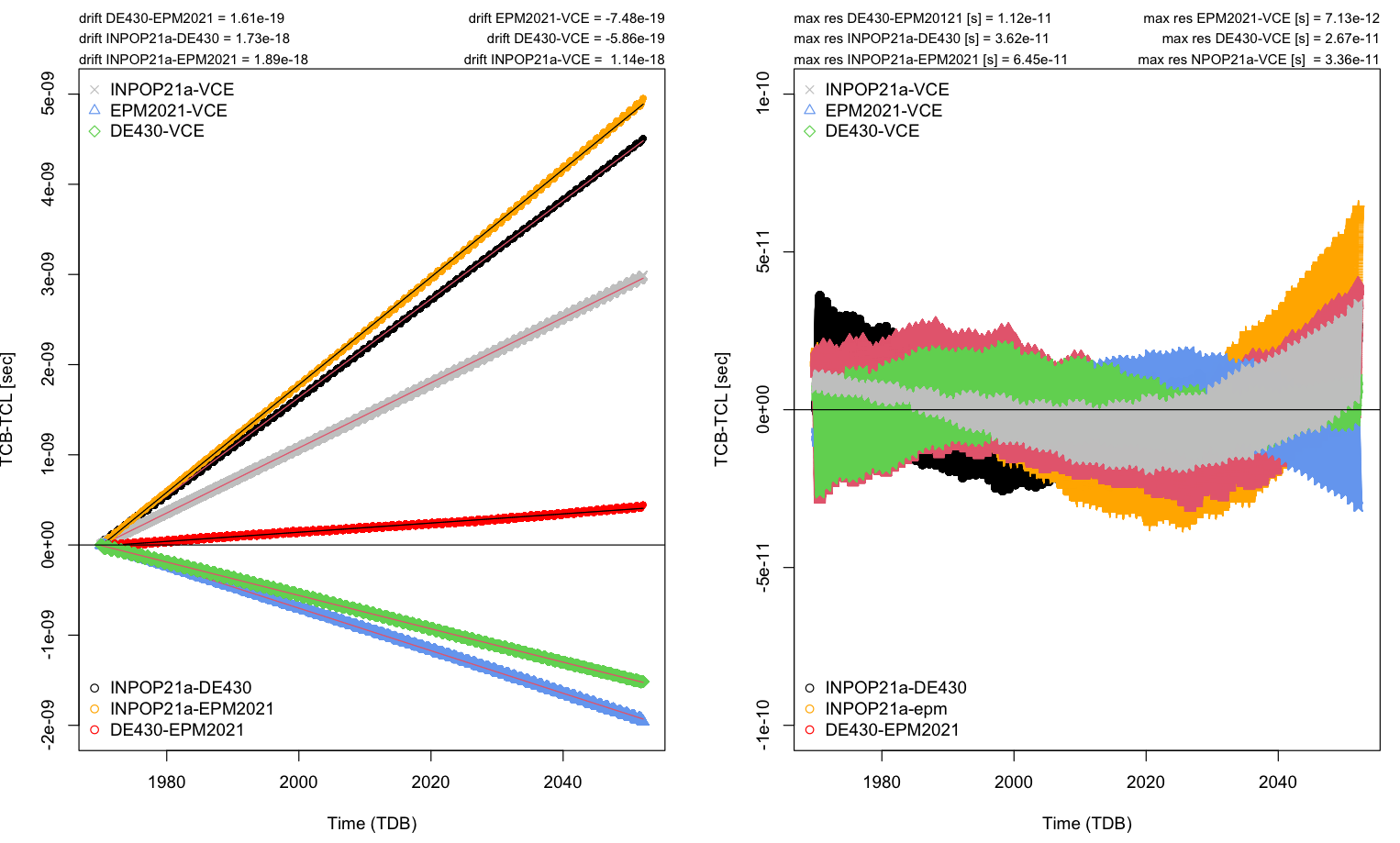
Only translation parameters are impacted by the time-scale transformation. The ASCII file with TCB/TCL-compatible transformation parameters can be found hereThe lunar time-scale TCL has been defined by IAU with its 2024 resolution. Based on this definition, INPOP21a, DE430 and EPM2021 computations of TCL-TCB have been obtained in using the sofware TEMPUS, considering the perturbations of the Sun and planets over 200 years.
The differences over 200 years between these computations are plotted here and show maximum drifts at level of 2 x 10e-18 which is far below the most stable clock on Earth. Detrended residuals have amplitudes below 65 ps.
For computing the TCL-TCB for ILuRF, (TCL_TCB)_ILuRF2026, we combined the 3 computations obtained with INPOP21a, DE430 and EPM2021 and compared previously, using the same weights as the one use for the ILuRF construction. Differences between (TCL_TCB)_ILuRF2026 and those of the 3 ephemerides are plotted on this Figure. Maximum drift in the differences is about 1 x 10e-18 over 200 years with 35 ps for the maximum amplitudes of the detrended residuals.